
The tabernacle was, on the surface, just instructions for a very large, very expensive tent. But every measurement given to Moses on the mountain was there for a reason — the tabernacle was a picture of Jesus Christ, a blueprint for the believer, and a shadow of salvation, all at once. Before looking at any single piece of furniture, it helps to see the whole picture.
A tent with a purpose
The tabernacle was a portable worship center for Israel in the wilderness — a tent large enough to require a whole camp to carry, torn down and rebuilt every time God said it was time to move. From the outside it was plain, even ugly: a 7½-foot fence and a covering of badger skin. But inside it was beautiful — color, gold, a lampstand throwing light on woven tapestry. That outside-in design is itself a picture of Jesus: Isaiah says there was nothing in His appearance that we should desire Him, yet to the believer who has come inside, He is altogether beautiful.
The tabernacle had three parts — an outer court like a yard, an inner court like a house, and a holiest of holies like a bedroom, the one place only a single priest could enter, once a year. That maps onto three parts of a person: a body (the outer court, what people can see), a soul (the inner court — mind, will, emotions, memory), and a spirit (the innermost court, the part that will spend eternity with God or without Him). And it maps onto salvation itself: coming through the wide door where all are welcome, encountering the altar of sacrifice, and moving toward the presence of God.
The foundation beneath the tent
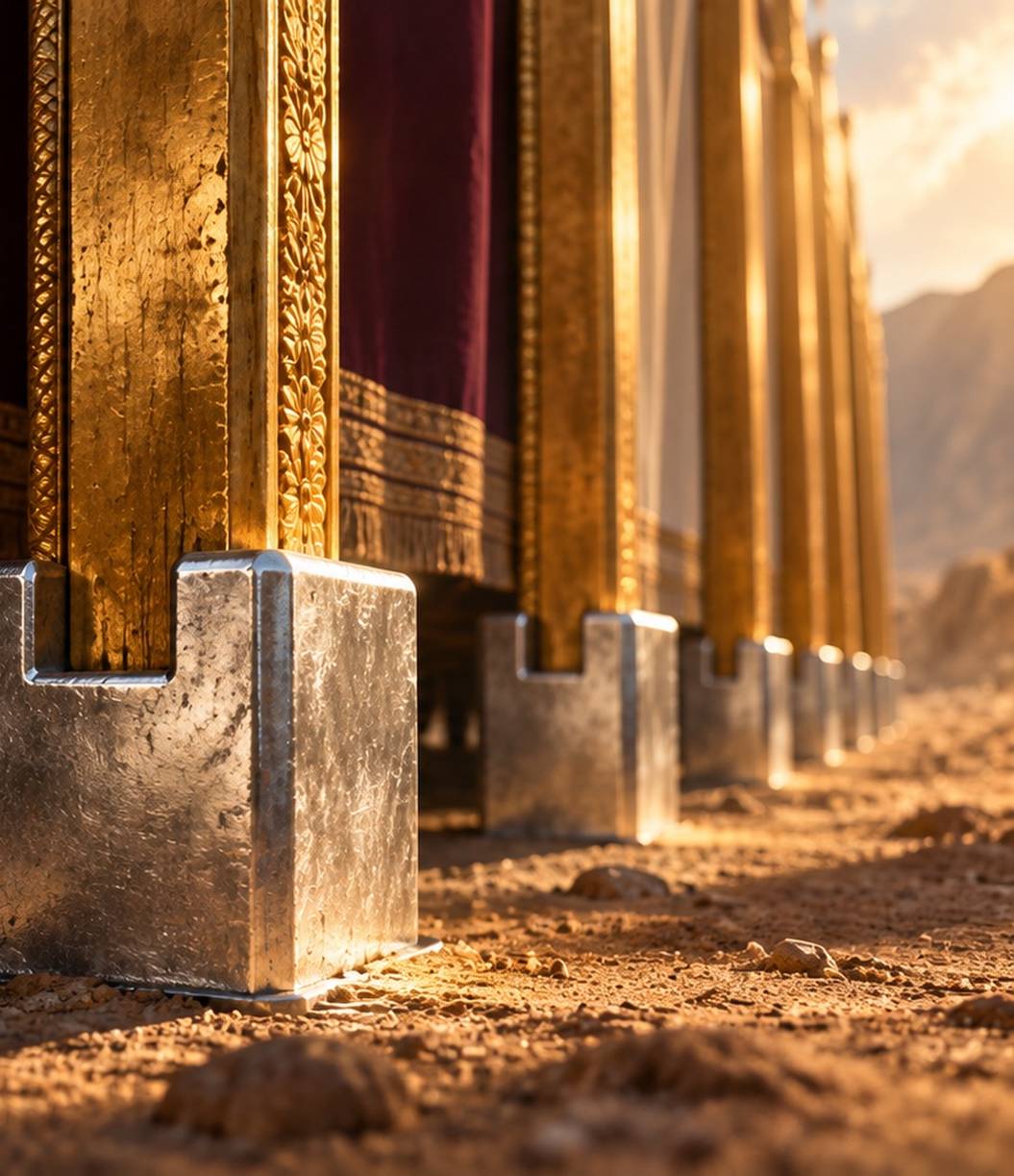
A tent this size, in a sandy wilderness, needed something more than tent pegs driven into the sand. Exodus gives the answer.
“Thou shalt make forty sockets of silver under the twenty boards.”Exodus 26:19
Adding up the sockets on every side of the tabernacle in Exodus 26 comes to one hundred blocks of silver, each weighing about a hundred pounds — nearly ten thousand pounds of silver, worth several million dollars at today's prices. Every board of the tabernacle rested in that foundation. This was not a decorative touch. It was what kept the entire structure from blowing away in a desert wind.
The source of the silver
Where did all of that silver come from? Not a lucky find in the wilderness — a specific, required offering.
“When thou takest the sum of the children of Israel after their number, then shall they give every man a ransom for his soul unto the Lord, that there be no plague among them.”Exodus 30:12
Every time Israel was numbered, each person paid a half-shekel — described as a ransom, an atonement for the soul.
“The rich shall not give more, and the poor shall not give less, than half a shekel, when they give an offering unto the Lord, to make an atonement for your souls.”Exodus 30:15
The rest of the tabernacle was funded by a freewill love offering — give if you want to. The silver was the one mandatory piece, and it was the same amount for everyone, rich or poor.
The symbolism: atonement that costs the same for everyone
Centuries later, writing to believers who no longer had a tabernacle to point back to, Peter makes the connection explicit.
“Forasmuch as ye know that ye were not redeemed with corruptible things, as silver and gold, from your vain conversation received by tradition from your fathers; but with the precious blood of Christ, as of a lamb without blemish and without spot.”1 Peter 1:18–19
No one who leads a person to Christ asks about their bank balance first. There is no minimum deposit for salvation, and there is no premium tier for the wealthy. Jesus shed exactly as much blood for the richest man in the room as for the poorest, and exactly as much for the openly guilty as for the respectable churchgoer who looks down on them. Dead is dead — Scripture says we are all dead in trespasses and sin before Christ — and the price to redeem every one of us was the same: the blood of Jesus.
The significance: a foundation that actually holds
Most of the tents in that wilderness camp sat directly on sand. When the storms came, those tents could blow away; the tabernacle, locked into its silver foundation, was not going anywhere. Jesus used the same picture to close the Sermon on the Mount.
“Every one that heareth these sayings of mine, and doeth them not, shall be likened unto a foolish man, which built his house upon the sand: and the rain descended, and the floods came, and the winds blew, and beat upon that house; and it fell: and great was the fall of it.”Matthew 7:26–27
A life can look stable for a while even without that foundation — there can be the illusion of stability, right up until the storm actually arrives.
For the one who already has
For believers, the challenge is different but related. We don't outgrow our need for the gospel. It is easy to treat sanctification as a checklist — read a chapter, say a prayer, show up on Sunday — while quietly keeping Jesus off to the side rather than at the center of every priority. And it is common to say “I'm saved” while still crumbling under pressure just as completely as before, because the tent stakes have drifted from the foundation without anyone noticing.
The question worth asking is not complicated, even if the honest answer sometimes is: is Jesus actually at the center, or is He one priority competing with several others? Are the tent stakes of daily life — where attention goes first thing in the morning, what shapes decisions, what gets trusted when trouble comes — still firmly planted in the silver foundation of the gospel?