
Almost all of the action in the book of Job happens in the first three chapters. Everything from chapter four to the end of the book is conversation — Job and his friends, and eventually Job and God. So before any of those conversations make sense, we need a clear picture of exactly what happened at the start. This lesson is titled “and so it begins.”
A real man, not a parable
Though the opening of Job reads dramatically, it is not religious fiction. Ezekiel and James both treat Job as a real historical person.
“Though these three men, Noah, Daniel, and Job, were in it, they should deliver but their own souls by their righteousness, saith the Lord God.”Ezekiel 14:14
“Ye have heard of the patience of Job, and have seen the end of the Lord.”James 5:11
Job lived in the land of Uz, likely near Edom, south of the Dead Sea — and well before Abraham. In the opening verse he is described plainly: “perfect and upright, and one that feared God, and eschewed evil” (Job 1:1).
Job’s prosperity
What made Job rich? First, his character — not sinless, but righteous and mature. Proverbs makes the same point: “Better is the poor that walketh in his uprightness, than he that is perverse in his ways, though he be rich” (Proverbs 28:6). Second, his family: seven sons and three daughters who genuinely got along, celebrating together at each other’s homes.
Third, his possessions — and this is where the scale of Job’s wealth becomes almost hard to picture. Job 1:3 lists 7,000 sheep, 3,000 camels, 500 yoke of oxen, and 500 female donkeys, along with “a very great household” of servants. Priced out today, that livestock alone runs into the tens of millions of dollars, before counting land, houses, or workforce. Job was, in the Bible’s own words, “the greatest of all the men of the east” (Job 1:3). And fourth, his friends — Eliphaz, Bildad, and Zophar, who we will meet again later in the series, and who traveled a real distance simply to sit with him.
Job’s adversity
Then, in a single day, four messengers arrive back to back, each one interrupting the last, each with worse news than the one before: raiders have taken the oxen and donkeys and killed the servants; fire has fallen from heaven and burned up the sheep; raiders have taken the camels and killed those servants too; and finally, a great wind has collapsed the house where all ten of his children were feasting together, killing every one of them.
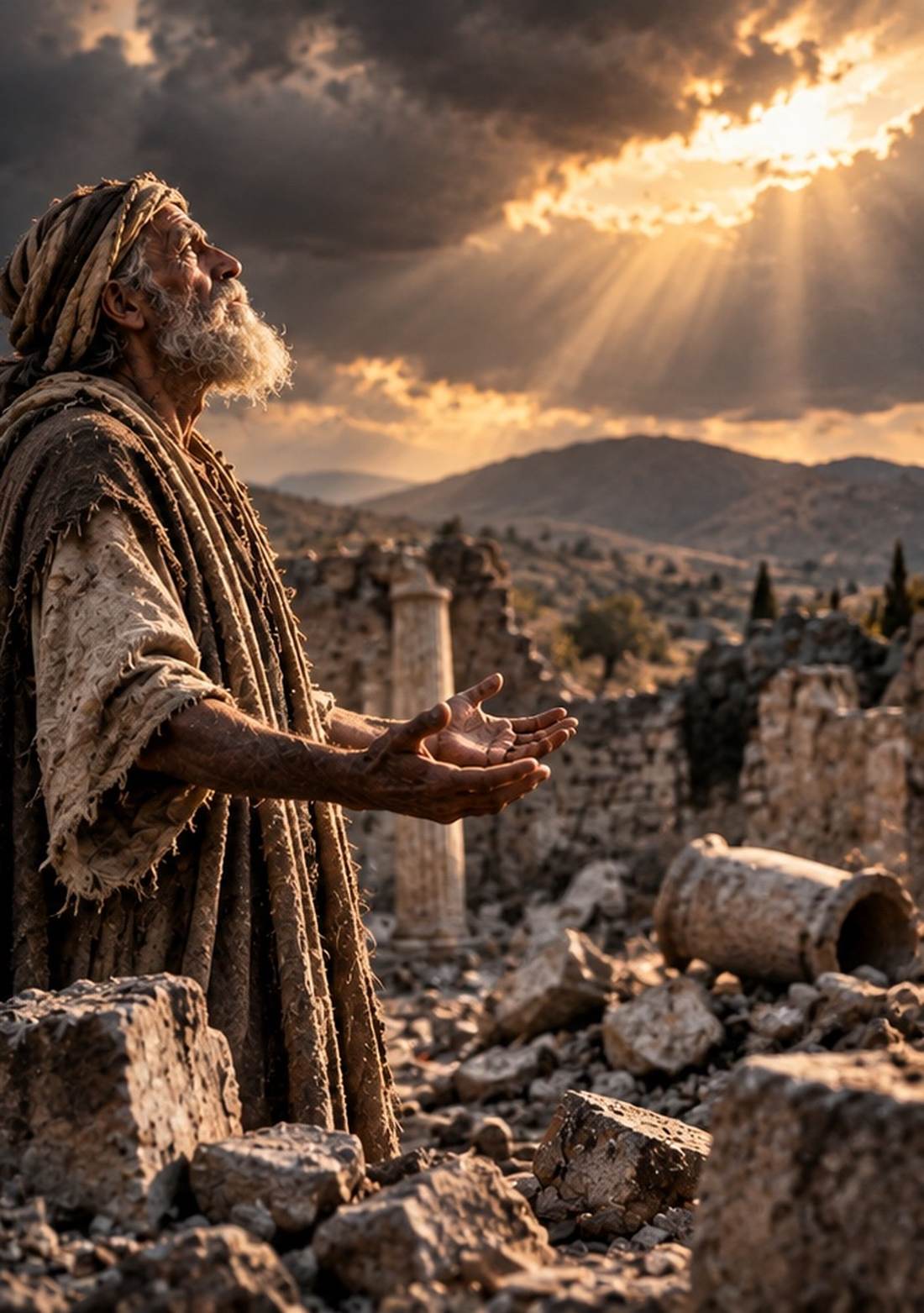
“Then Job arose, and rent his mantle, and shaved his head, and fell down upon the ground, and worshipped.”Job 1:20
What this reveals
Several foundational principles come out of these two chapters, and they carry the rest of the book. God is sovereign in all things, and Satan has access to God’s throne — a strange but repeated detail (Job 1:6; 2:1) that shows God is never off the throne, even when Satan is active in the world. God found no fault with Job, but Satan did (Job 1:8) — a reminder that Satan is “the accuser of our brethren” (Revelation 12:10), and the condemning voice in our own heads is never the voice of the Holy Spirit.
Suffering is not always the result of personal sin. Job’s friends will eventually assume otherwise, and they will be wrong. God’s purposes are often hidden from us — Job never learned about the conversation in heaven; he stayed faithful without ever getting the explanation. As Moses wrote, “the secret things belong unto the Lord our God” (Deuteronomy 29:29). Earthly blessings are gifts, not guarantees — everything Job had was entrusted to him, and God had every right to give and every right to take away. And finally, our character is revealed in adversity, not in prosperity. Satan’s wager was that taking Job’s possessions would expose a curse waiting to happen. Instead it exposed a faith that had been real all along.
Where we go from here
Job’s story begins with extraordinary blessing and ends, in these opening chapters, with unimaginable loss — but neither one defined him. What defined Job was his unwavering faith in a sovereign God. Every believer will face an ash heap of some kind. The goal is not simply to endure it, but to look beyond it, to the God who remains faithful on the other side of it.
Next week: Job’s integrity and his misery — how he grieved honestly without ever cursing God, and four voices we can expect to hear in our own hardest days.