
So far in this series: a silver foundation worth millions, resting on a ransom paid the same for rich and poor; boards cut from the wilderness, covered in gold, and locked together into something built to last; and colors and coverings that gave the whole structure its beauty. Now, finally, we step through the door and meet the first piece of furniture — the altar.
The pattern of the altar
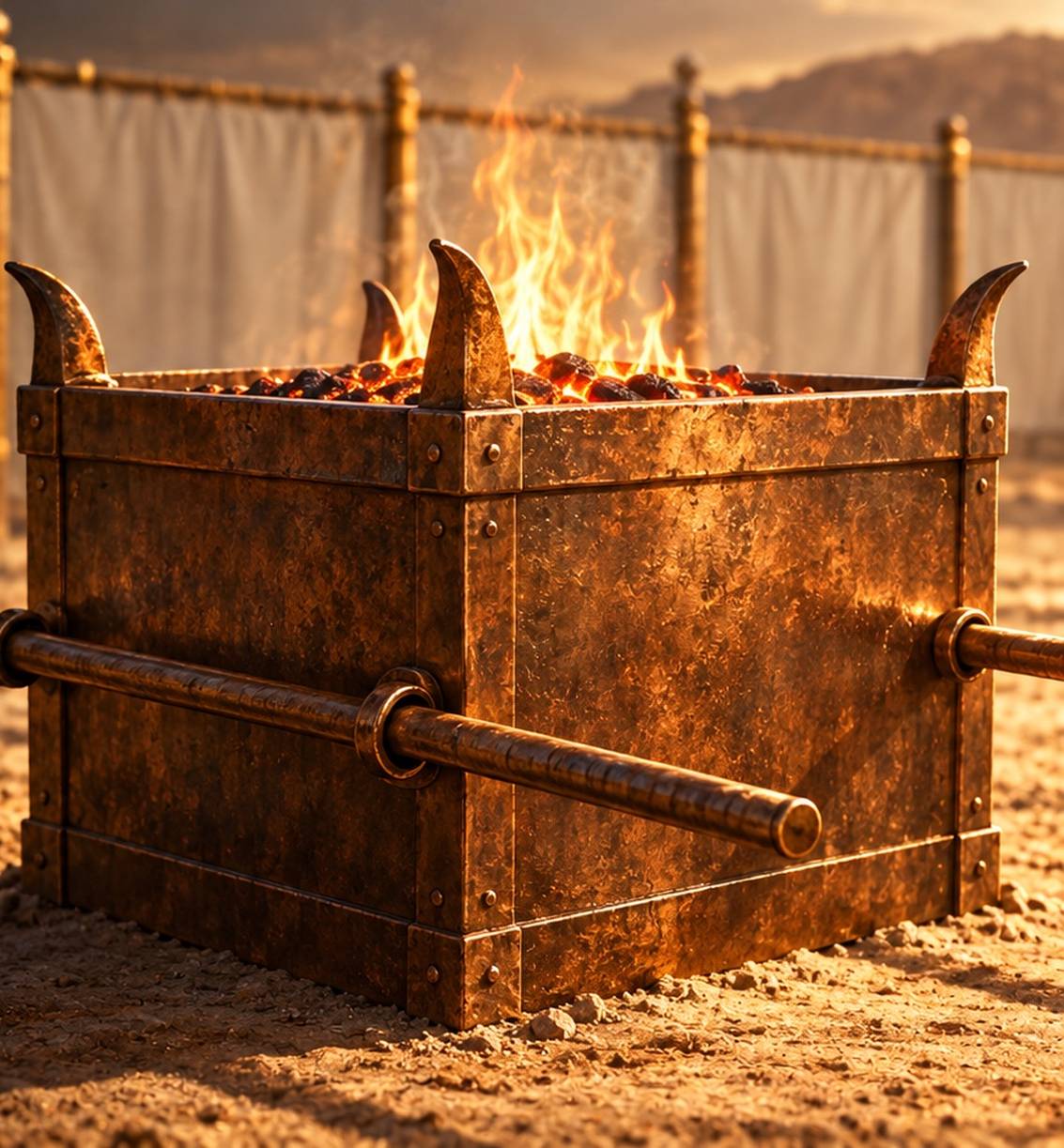
“Thou shalt make an altar of shittim wood, five cubits long, and five cubits broad; the altar shall be foursquare: and the height thereof shall be three cubits.”Exodus 27:1
God gave Moses exact dimensions, and the numbers themselves carry meaning: five is the number of grace and provision throughout Scripture (the five offerings of Leviticus 1–7, David's five smooth stones); three is the number of deity and resurrection (three persons in the Godhead, the third-day resurrection); four is the number of the earth, as in the “four corners of the earth” (Isaiah 11:12). A five-by-five-by-three altar, foursquare, pictures divine grace reaching the whole earth through resurrection life.
The altar itself symbolizes the cross — the place where sacrifice was made for the sin of the people, just as the cross is where sacrifice was made for the sin of all mankind.
Wood and bronze: humanity meets judgment
“Thou shalt make the horns of it upon the four corners thereof: his horns shall be of the same: and thou shalt overlay it with brass.”Exodus 27:2
Wood pictures humanity, as it did with the boards. Bronze pictures judgment — the same bronze God used for the serpent Moses lifted up in the wilderness so that anyone who looked at it in faith would live (Numbers 21:8–9; John 3:14). Wood and bronze together on the altar hold two truths in tension: humanity under judgment, and grace reaching down to meet it.
That tension is the real question behind the altar: why did Jesus have to die? Why couldn't a loving God simply overlook sin? Because God is completely just — He cannot look on sin without judgment — and completely loving, unwilling to leave people under that judgment forever. An old illustration captures it: a king's own daughter is caught stealing from his treasury, under a decree that the penalty is a flogging severe enough to kill. The king cannot be just and simply forgive her, and he cannot be loving and simply flog her. So on the day of judgment, he steps between the whip and his daughter and takes the blow himself. That is the cross — the only place where perfect justice and perfect love could both be fully satisfied.
The horns: the power of the cross
Horns in Scripture symbolize strength and kingdoms (Daniel 7:7–8; 1 Samuel 2:10). The four horns on the altar's corners picture the power of the cross, reaching to all four corners of the earth.
“I am not ashamed of the gospel of Christ: for it is the power of God unto salvation.”Romans 1:16
“And I beheld, and, lo, in the midst of the throne… stood a Lamb as it had been slain, having seven horns.”Revelation 5:6
Seven horns doesn't mean Jesus literally has seven horns — it means perfect power. The gospel is available to every people, every tongue, every nation, in every corner of the earth: Jew or Greek, bond or free, all one in Christ.
The position: no way to God around the cross
“Thou shalt kill the bullock before the Lord, by the door of the tabernacle of the congregation.”Exodus 29:11
The altar stood immediately inside the wide door where anyone was welcome to enter. That placement is the point: you cannot come to God without passing the altar, just as you cannot come to God without passing the cross. There is no back entrance and no employees-only door. “Without shedding of blood is no remission” (Hebrews 9:22) — whatever else a person hopes to find further inside the tabernacle, the light of the lampstand, the bread of the table, none of it is reachable except by first coming through the altar.
The purpose: a sacrifice for sin, and the fire that never went out
The altar existed for one purpose — so that people with a sin problem could make a sacrifice for it. Israel had a sin problem then; the world still has one now, however uncomfortable it is to name it that plainly. And the fire on the altar, lit once by God and never allowed to go out, pictured His consuming wrath against that sin.
“For our God is a consuming fire.”Hebrews 12:29
God's hatred of sin is exactly as strong today as it was three thousand years ago. What changed is that Jesus Christ took that wrath — the fire that would otherwise fall on the sinner — onto Himself at the cross.